


The Developing Mind on Trial: Young Age Under Maltese And International Criminal Law
The Developing Mind on Trial: Young Age Under Maltese and International Criminal Law
Author: Megan Ekezie (Second-year Bachelor of Laws student and Director for Academic Activities at ELSA Malta)
Under Maltese criminal law, young age operates as a partial or complete defence rooted in the recognition that a child’s mental capacity is still developing. The law acknowledges that minors may lack the maturity required to fully distinguish between right and wrong, thereby justifying a differentiated treatment from adults. This approach is primarily codified in Articles 35 to 37 of the Criminal Code, Chapter 9 of the Laws of Malta (with Article 36 having been repealed), which establish distinct age categories and introduce the concept ofmischievous discretion as a specific standard applicable to minors.
Criminal Responsibility and Criminal Liability
A fundamental distinction must first be drawn between criminal responsibility and criminal liability. Criminal responsibility refers to the capacity of an individual to be blamed under substantive criminal law for the commission of an offence. Criminal liability, on the other hand, concerns the legal consequences flowing from the offence, including punishment or other penal measures. In the case of minors, Maltese law deliberately separates these two concepts in order to reflect their reduced moral culpability.
As will be discussed, a minor is not held criminally responsible under substantive law, however, the minor is criminally liable under penal law with such liability being visited on the parents, or the persons in charge of the upbringing of the child, which is done on the application of the Police as outlined in Article 35(2) of the Criminal Code.[1] It is crucial to clarify that the liability visited upon parents or guardians under Article 35(2) does not constitute a transfer of vicarious criminal responsibility for the act itself since the child is strictly incapable of committing a crime, but rather functions as a distinct penal consequence regarding the supervision and upbringing of the minor.
Under Article 35(1)[2] of the Criminal Code (as amended in 2014), a child under fourteen years of age shall be exempt from criminal responsibility for any act or omission. This provision codifies the doctrine of doli incapax—the presumption that a child is incapable of committing a crime. Importantly, this presumption is jure et de jure, meaning it is irrebuttable: no evidence whatsoever may be adduced to prove that a child under fourteen possessed the cognitive or moral capacity to commit an offence. This absolute exemption represents a significant evolution in Maltese law as will be further on illustrated.
A more nuanced approach applies under Article 37(1)[3] to minors aged between fourteen and sixteen. Here, the law presumes the absence of criminal responsibility unless the prosecution proves that the minor acted with “mischievous discretion”. This presumption is juris tantum, and therefore rebuttable. This means that if the evidence establishes that the minor possessed sufficient understanding to appreciate the wrongfulness of their conduct, criminal responsibility may arise.
Mischievous Discretion
The notion of mischievous discretion is central to understanding youth criminality in Maltese law. Unlike criminal intent, mischievous discretion does not require the full cognitive and moral awareness expected of an adult offender. Instead, it refers to a basic capacity to understand that an act or omission is wrong or harmful and to consciously choose to engage in that conduct.
Having said that, mischievous discretion is a subjective standard. This distinction between criminal intent and mischievous discretion is crucial. The traditional elements of the actus reus (which is the physical act) and the mens rea (the guilty mind) are thus adapted rather than strictly applied in this context. The mischievous discretion standard thus serves as a developmental filter, ensuring that criminal responsibility is imputed only where a child has developed sufficient understanding to merit such responsibility.
Article 37[4] further illustrates the distinction between responsibility and liability. Where a minor aged fourteen to sixteen acts with mischievous discretion, or where a minor is aged between sixteen and eighteen, criminal liability may arise, but the penalty imposed is reduced by one or two degrees. This statutory mitigation reflects the law’s acknowledgment of young age as a factor diminishing culpability, even where responsibility is established.
Here, the burden thus falls upon the prosecution to demonstrate that the minor possessed sufficient understanding to appreciate the wrongfulness of their conduct and consciously chose to act upon that understanding. This represents a middle ground between absolute protection and full culpability: the minor is not automatically presumed to be responsible, yet responsibility may be established if adequate evidence is presented.
Prior to 2014, the age of criminal responsibility was set at twelve years, with children aged twelve to fourteen being held criminally responsible where mischievous discretion was established. As discussed in Professor Mamo’s notes, the threshold was once set even lower, with minors under the age of nine being exempt from criminal liability.
The increase in the minimum age of criminal responsibility to fourteen in 2014 reflects guidance from the United Nations Committee on the Rights of the Child and broader international standards aimed at strengthening the protection of young persons.[5]
England and Wales
Moving onto an international landscape, England and Wales establishes the age of criminal responsibility at ten years, which is the lowest in Europe.[6] Children under ten are absolutely presumed incapable of committing a crime. However, the most significant distinction between England and Wales and Malta lies in the treatment of children aged between ten and thirteen (or fourteen, under the pre-1998 framework).
In 1998, the then-Labour government legislated for the abolition of doli incapax through Section 34 of the Crime and Disorder Act 1998.[7] The government's stated rationale was that children by the age of ten possess sufficient understanding to know the difference between right and wrong, and that the presumption of incapacity was therefore an impediment to holding young offenders appropriately accountable.
The matter was revisited by the Court of Appeal in R v JTB[8] where the judges examined Parliament’s purpose in enacting section 34 of the 1998 Act. The Court concluded that because the government had dismissed the alternative of reversing, rather than eliminating, the presumption, the legislative intent was to remove the doctrine of doli incapax altogether. The judges observed that had Parliament opted merely to reverse the presumption, children would still have been able to rely on doli incapax as a defence.
The Italian Framework
The Italian Criminal Code addresses juvenile criminal responsibility through Articles 97 and 98, which establish an architecture broadly comparable to Malta's framework, though employing different terminology. Article 97 provides that minors who have not attained fourteen years of age ‘non è imputible’ (cannot be held criminally liable), as it is presumed that they lack capacity to understand the nature of their conduct and to form the necessary criminal intent.[9] This presumption is absolute and irrebuttable.
Article 98 extends responsibility to minors aged between fourteen and eighteen years, but subjects them to a critical requirement: the court must ascertain whether the minor possessed ‘la capacità d'intendere e di volere’ (capacity to understand and the capacity to will) at the moment of committing the offence.[10] This assessment is not presumed but must be proven through concrete examination of the individual case.[11] In this respect, the Italian approach parallels Malta's requirement to establish mischievous discretion, though the Italian terminology emphasises the dual elements of understanding and volition.
Where a minor aged fourteen to eighteen is found criminally responsible in Italy, penalties are substantially reduced. Similar to Malta, the Italian system employs a system of mitigation reflecting the reduced culpability of adolescent offenders. The emphasis throughout the Italian framework is upon assessment of individual maturity rather than mechanical age thresholds, recognising that development is not uniform across all children.
Convergence and Divergence
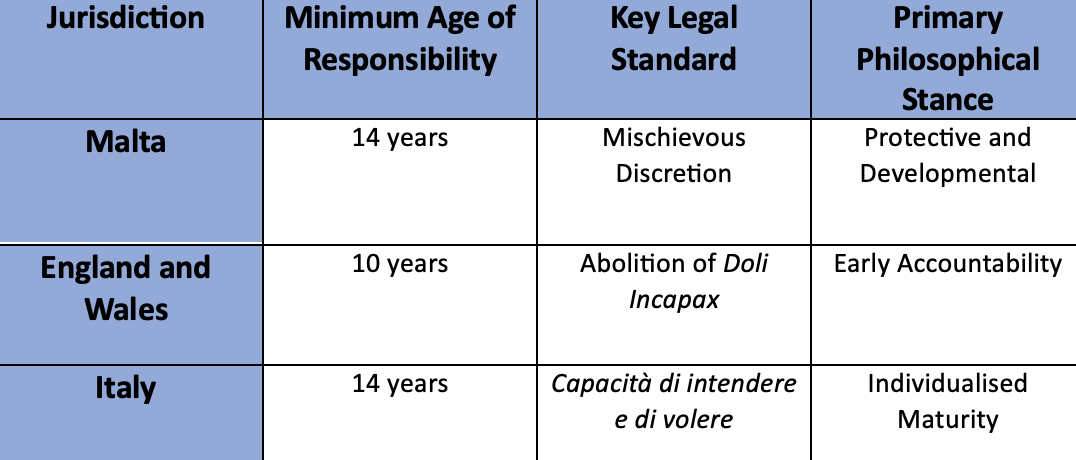
The three jurisdictions examined share common ground in recognising that young age affects criminal culpability and justifies differentiated legal treatment. All three establish an age below which absolute criminal responsibility cannot be imposed (fourteen years in Malta and Italy; ten years in England and Wales). All three jurisdictions provide for reduced penalties for young offenders.
However, the jurisdictions diverge fundamentally in their philosophical approach. Malta and Italy maintain robust protective presumptions for minors aged fourteen to sixteen/eighteen, placing the burden upon the prosecution to establish sufficient maturity before responsibility can be imputed. England and Wales abolished any rebuttable presumption, instead placing the burden effectively upon the child to demonstrate their immaturity as a mitigating factor at sentencing rather than as a barrier to prosecution.
To recapitulate, the following table illustrates the judicial development of young age under different jurisdictions:
International Standards and the UN Convention on the Rights of the Child
The UN Committee on the Rights of the Child has emphasised that the minimum age of criminal responsibility should not be lower than twelve years, and preferably higher.[12] The Committee recognises that children below this age generally lack the emotional, mental, and intellectual maturity required to be held responsible for criminal conduct.
In light of this, Malta's standard of fourteen years aligns with international best practice and the position of most European states. Italy's equivalent standard mirrors Malta's. By contrast, England and Wales, with its minimum of ten years (and effective abolition of protective presumptions), falls below international standards and stands in isolation within Europe.
Considering all of this, should the age at which minors can be held criminally responsible be reconsidered in Malta?
This is a pertinent question which requires deep thought and analysis. While these legal frameworks rely on chronological thresholds, the underlying justification for such lines is essentially increasingly found in the realm of developmental neuroscience.
A Minor’s Psychological Development
Developmental psychology has increasingly demonstrated that adolescent cognition, particularly in respect of impulse control and consequence-evaluation, continues to develop well into the early twenties.[13] According to Stanford Medicine Children’s Health, adolescent cognitive development is characterised by a fundamental transition from ‘concrete’ thinking, which is logic tied to immediate, physical realities, to ‘formal logical operations’, which encompass abstract reasoning and metacognition.[14]
This progression enables individuals between the ages of twelve and eighteen to begin weighing multiple perspectives, questioning societal standards, and anticipating hypothetical outcomes.[15] However, because these cognitive faculties are in a state of flux, the ability to apply systematic logic is often inconsistent. From a legal perspective, this developmental trail suggests that a minor’s capacity for foresight is biologically distinct from that of an adult, as the cognitive infrastructure required for sophisticated risk assessment and long-term consequence mapping is still maturing.
Furthermore, the internalisation of moral frameworks and stable ethical codes occurs gradually, often not reaching maturity until late adolescence. During this period, ‘asynchronous development’ frequently occurs, where a minor may demonstrate logical proficiency in controlled environments (let us consider a classroom) but experience a total collapse of complex reasoning under emotional stress or peer pressure, a phenomenon often referred to in legal scholarship as ‘hot cognition.’[16] Since identity and personal ethics are still being forged during these years, the adolescent brain is more susceptible to impulsive decision-making and external influence.
When assessing criminal responsibility and liability, these developmental markers provide a critical argument for diminished culpability, as they indicate that a minor’s actions may be the result of a transitory developmental stage rather than a fixed character trait or fully formed criminal intent.
Mischievous Discretion and Minor’s Psychological Development
When assessing mischievous discretion, Malta’s current framework provides a defensible and internationally compliant standard. Future reform discussions might productively examine whether the concept of mischievous discretion might be extended to minors aged sixteen to eighteen, thereby providing greater flexibility in recognition of individual developmental variation. Additionally, greater integration of forensic psychological expertise into juvenile court proceedings, following the Italian model, could provide a more robust framework for assessing mischievous discretion.
The Architecture of Culpability
The evolution of Maltese law from a threshold of nine years to the current standard of fourteen is more than a legislative update; it is a profound admission that the "guilty mind" is not born but built. By enshrining the doctrine of doli incapax and the nuanced filter of mischievous discretion, Malta has chosen to prioritise developmental reality over the reflexive desire for retribution.
Yet, as neuroscience continues to map the ‘hot cognition’ of the adolescent brain, we are forced to confront a growing tension between the static lines of the Criminal Code and the fluid nature of human maturity. If a sixteen-year-old’s impulse control is biologically indistinguishable from that of a thirteen-year-old, does our current reliance on chronological age hold up to scientific scrutiny?
The contrast between the protective frameworks of Italy and Malta and the more punitive stance of England and Wales highlights a global identity crisis in juvenile justice. Are we punishing the deed, or the stage of life? As we look toward future reforms, the challenge for the Maltese legislator will not merely be to adjust age brackets, but to decide whether the law should continue to be a rigid hammer or evolve into a diagnostic tool.
If the law is to be truly just, can it continue to treat the “mischievous” choices of a developing mind as though they were the fully formed acts of a criminal mind?
The answer may require us to rethink not only when a child becomes an adult, but also what it truly means for a society to hold its youth accountable. The challenge, therefore, is no longer merely to determine a specific age, but to ensure that our laws align with the neurological realities of the developing mind.
[1] Criminal Code, Chapter 9 of the Laws of Malta, Article 35(2).
[2] ibid Article 35.
[3] ibid Article 37(1).
[4] ibid Article 37(1) and Article 37(2).
[5] Office of the United Nations High Commissioner for Human Rights, ‘Committee on the Rights of the Child examines report of Malta’ (United Nations Office of the High Commissioner for Human Rights, 16 May 2019) <https://www.ohchr.org/en/press-releases/2019/05/committee-rights-child-examines-report-malta> accessed 25 February 2026.
[6] UK Government, ‘Age of Criminal Responsibility’ (GOV.UK, 27 February 2023) <https://www.gov.uk/age-of-criminal-responsibility> accessed 24 February 2026.
[7] The Howard League, ‘Punishing Children: a survey of criminal responsibility and approaches across Europe’ (The Howard League for Penal Reform, 2008) <https://howardleague.org/wp-content/uploads/2016/05/HL-Punishing-Children-Report-Print1.pdf> accessed 25 February 2026.
[8] R v JTB [2009] UKHL 20 (on appeal from the Court of Appeal (Criminal Division)) <https://publications.parliament.uk/pa/ld200809/ldjudgmt/jd090429/jtb-1.htm> accessed 23 Febraury 2026.
[9] Codice Penale (R.D. 19 ottobre 1930, n. 1398) Article 97.
[10] ibid Article 98.
[11] ibid.
[12] United Nations Committee on the Rights of the Child, General Comment No.10 Para.33 < https://www.refworld.org/legal/general/crc/2007/en/43085> accessed 26 February 2026.
[13] Laurence Steinberg, ‘A Social Neuroscience Perspective on Adolescent Risk-Taking’ Dev Rev. 2008 (PubMed Central, 27 May 2008) <https://pmc.ncbi.nlm.nih.gov/articles/PMC2396566/> accessed 25 February 2026.
[14] Stanford Medicine Children’s Health, ‘Cognitive Development in the Teen Years’ (Stanford Medicine Children’s Health) <https://www.stanfordchildrens.org/en/topic/default?id=cognitive-development-in-the-teen-years-90-P01594> accessed 25 February 2026.
[15] ibid.
[16] Rachel Barkin, ‘Hot and Cold Cognition: Understanding Emerging Adults’ Cognitive Reasoning’ (Columbia University Justice Lab, December 2021) <https://justicelab.columbia.edu/sites/justicelab.columbia.edu/files/content/Hot%20and%20Cold%20Cognition.pdf> accessed 8 March 2026.